
 English
 한국어
한국어 中文简体
中文简体Soft Magnetic Ferrites: Properties, Types & Applications
Content
What Are Soft Magnetic Ferrites?
Soft magnetic ferrites are ceramic-like magnetic materials composed primarily of iron oxide (Fe₂O₃) combined with one or more metallic oxides — most commonly manganese (Mn), zinc (Zn), or nickel (Ni). Unlike hard (permanent) magnets, soft magnetic ferrites can be magnetized and demagnetized rapidly and repeatedly with minimal energy loss, making them indispensable in high-frequency electronic applications.
The two dominant families are MnZn ferrites and NiZn ferrites. MnZn ferrites offer higher permeability and saturation flux density, while NiZn ferrites excel at frequencies above 1 MHz due to their higher electrical resistivity. This fundamental split drives nearly every material selection decision in power electronics and RF engineering.
Key Magnetic Properties and Performance Metrics
Selecting the right soft magnetic ferrite requires understanding several interdependent parameters:
- Initial Permeability (µᵢ): Ranges from ~100 for NiZn grades to over 15,000 for high-permeability MnZn grades. Higher µᵢ enables smaller core sizes at low frequencies.
- Saturation Flux Density (Bsat): MnZn ferrites typically reach 400–530 mT at 25 °C, outperforming NiZn (300–380 mT). At elevated temperatures, Bsat drops — a critical factor for automotive and industrial designs.
- Core Loss (Pcv): Expressed in kW/m³, core loss determines thermal efficiency. State-of-the-art power MnZn grades achieve below 300 kW/m³ at 100 kHz / 200 mT — enabling higher switching frequencies without excessive heat.
- Curie Temperature (Tc): The point at which ferrimagnetic ordering collapses. Most commercial MnZn ferrites have Tc between 200 °C and 300 °C; specialty grades push beyond 400 °C for harsh-environment use.
- Electrical Resistivity: NiZn ferrites (10⁵–10⁷ Ω·cm) are orders of magnitude more resistive than MnZn (0.1–10 Ω·cm), which is why NiZn dominates above 1 MHz where eddy current losses become severe.
| Property | MnZn Ferrite | NiZn Ferrite |
|---|---|---|
| Frequency Range | 1 kHz – 1 MHz | 1 MHz – 300 MHz |
| Initial Permeability (µᵢ) | 1,500 – 15,000 | 100 – 1,500 |
| Bsat (mT, 25 °C) | 400 – 530 | 300 – 380 |
| Resistivity (Ω·cm) | 0.1 – 10 | 10⁵ – 10⁷ |
| Typical Curie Temp. | 200 – 300 °C | 150 – 450 °C |
Manufacturing Process: From Powder to Finished Core
Producing consistent soft magnetic ferrites involves tightly controlled ceramic processing steps, where small deviations in any stage translate directly into magnetic performance variation:
- Raw Material Mixing: High-purity Fe₂O₃, MnO/NiO/ZnO powders are weighed and blended to precise molar ratios. Dopants such as CaO, SiO₂, or Co₂O₃ are added at the ppm level to tune loss characteristics.
- Pre-sintering (Calcination): The mixed powder is calcined at 850–950 °C to initiate spinel structure formation and reduce surface area before milling.
- Milling & Granulation: Calcined powder is wet-milled to sub-micron particle sizes, then spray-dried into free-flowing granules suitable for die pressing.
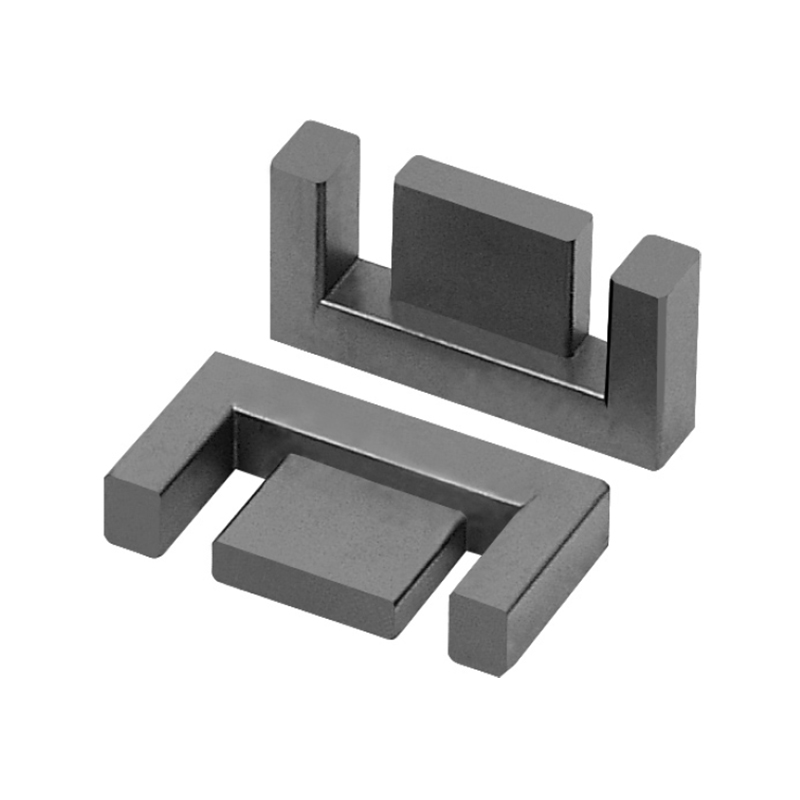
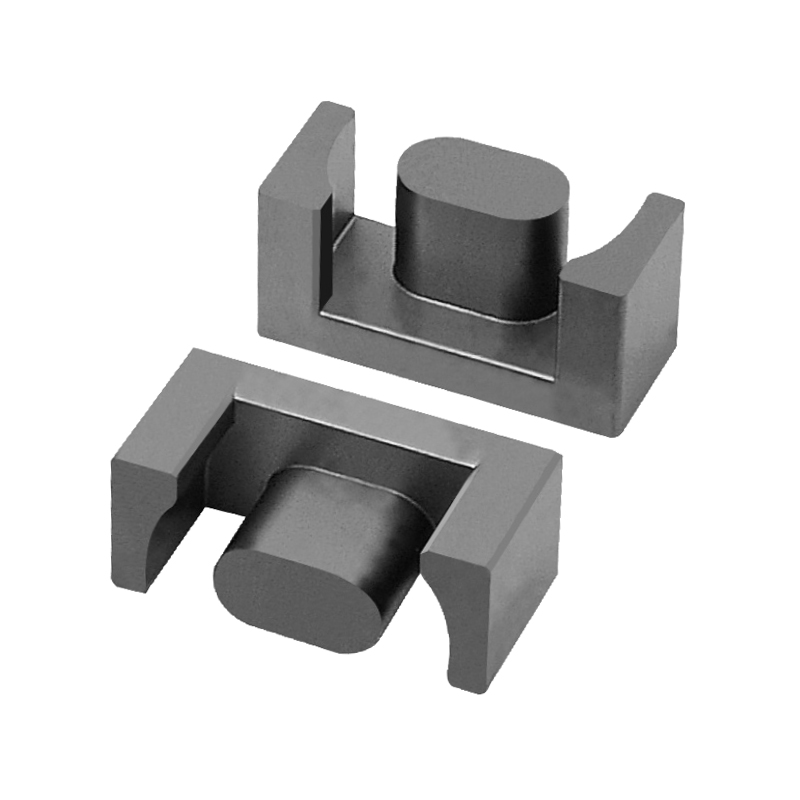
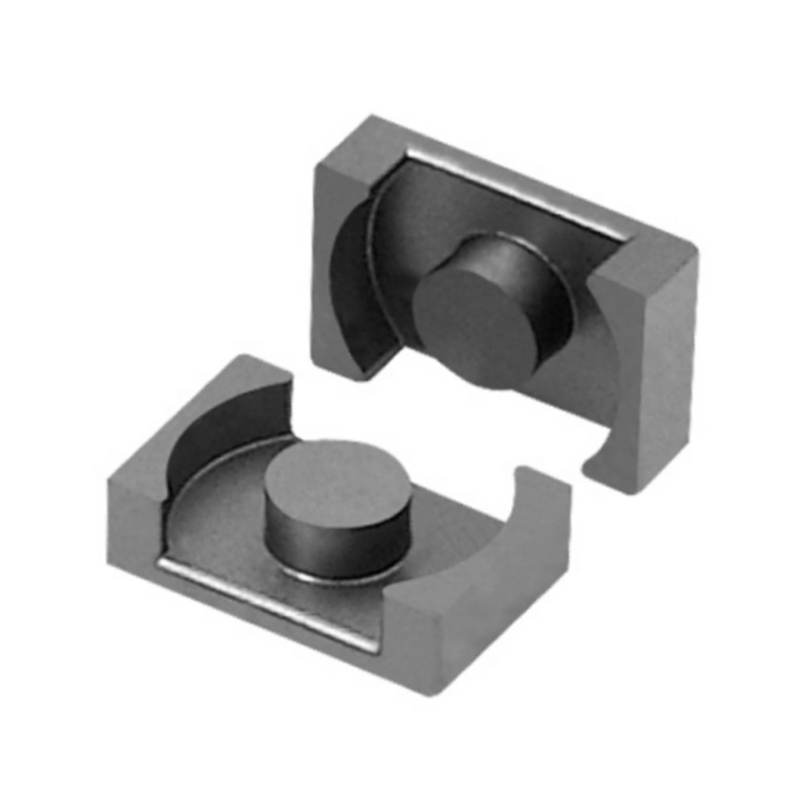
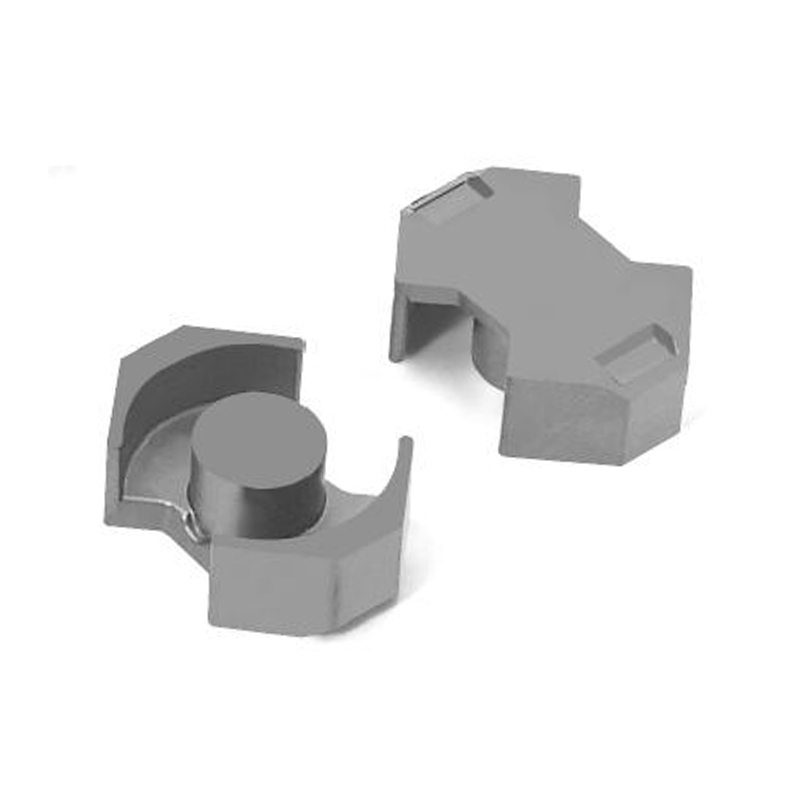
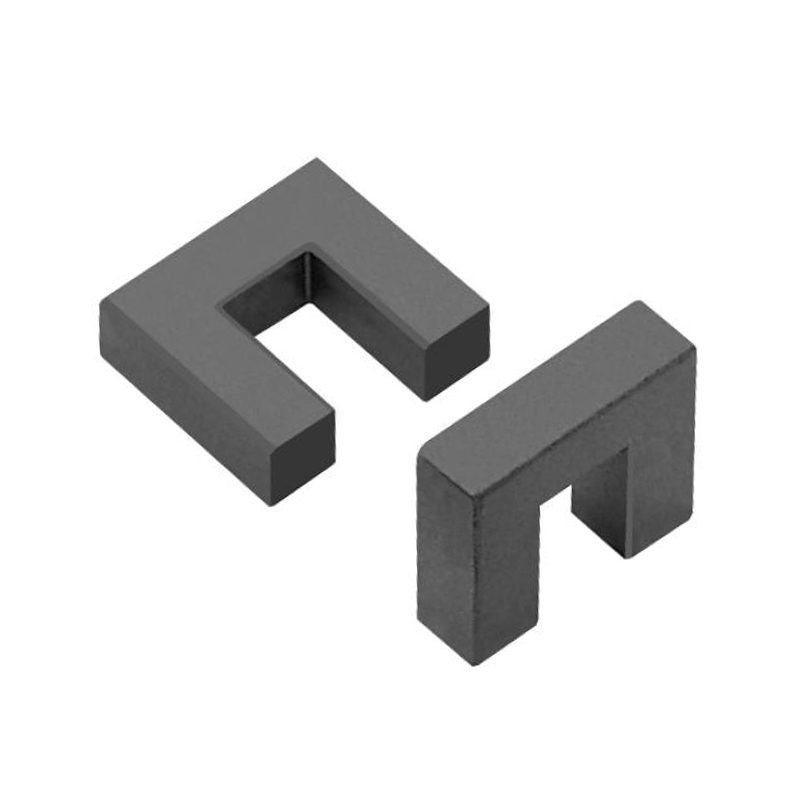
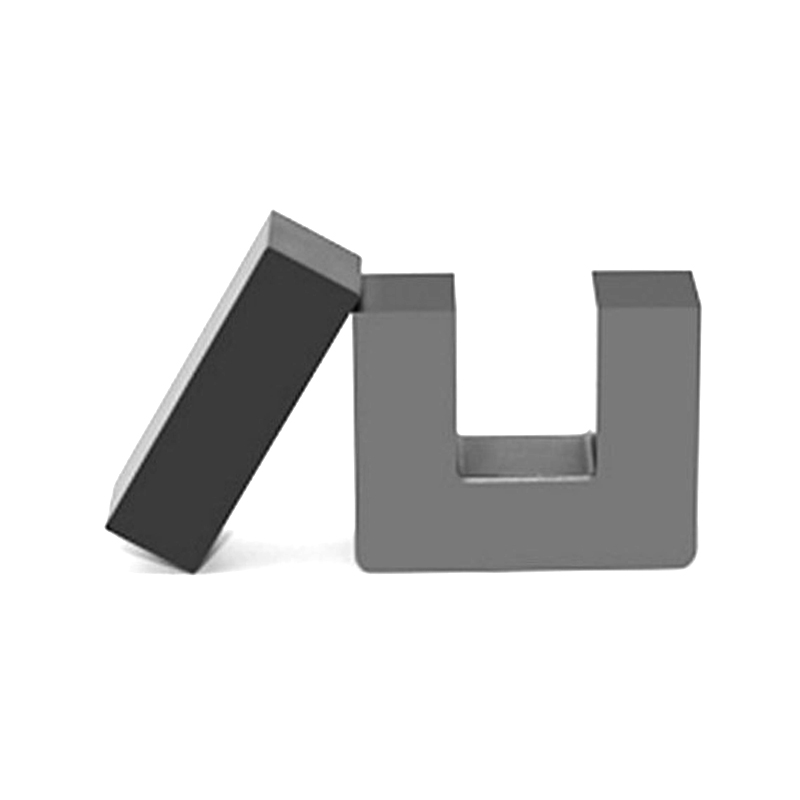
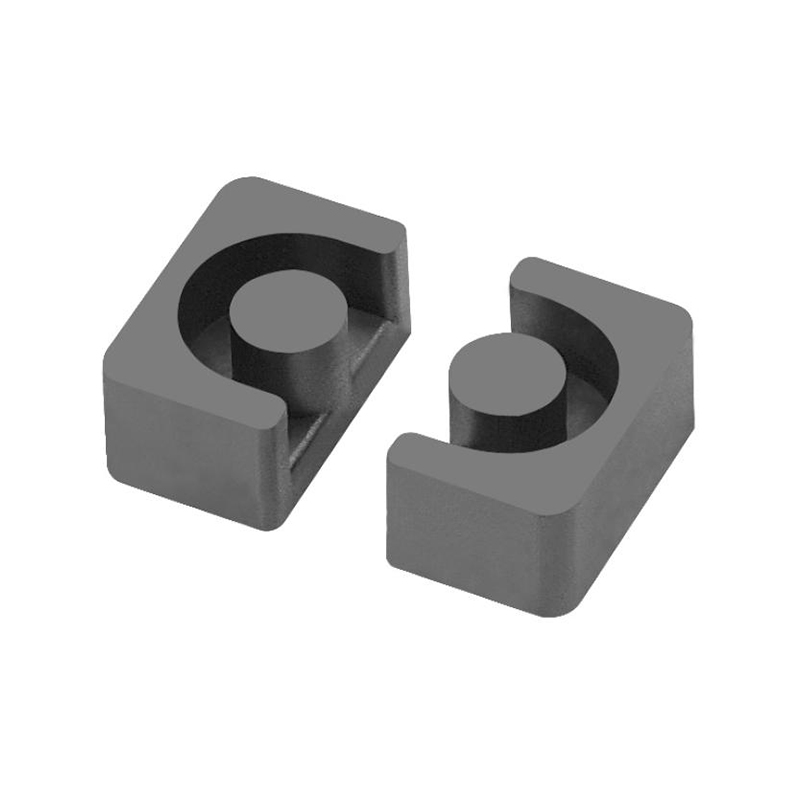
- Pressing: Granules are compacted into green bodies using uniaxial or isostatic pressing. Core shape — E, I, U, toroid, pot core, etc. — is determined at this stage.
- Sintering: Green cores are fired in controlled-atmosphere kilns at 1,100–1,350 °C. Oxygen partial pressure during cooling is the single most critical variable for MnZn ferrites, directly governing the Fe²⁺/Fe³⁺ ratio and hence final permeability and losses.
- Finishing & Testing: Sintered cores are lapped or ground to dimensional tolerances, then 100% tested for inductance, permeability, and loss factor on automated impedance analyzers.
Core Applications Across Industries
Soft magnetic ferrites have embedded themselves into virtually every sector that handles electrical energy or electromagnetic signals:
Power Electronics & Energy Conversion
Switch-mode power supplies (SMPS), LLC resonant converters, and PFC inductors rely on MnZn ferrite cores to achieve efficiency levels above 94% at switching frequencies of 50–500 kHz. The global SMPS market exceeded USD 40 billion in 2024, with ferrite cores as a fundamental bill-of-materials item. As power density requirements intensify, grades with minimized core loss at elevated temperatures (e.g., 100 °C operating conditions) are increasingly specified.
Electric Vehicles and On-Board Chargers
EV on-board chargers (OBC) and DC-DC converters operate at 100–300 kHz over wide temperature ranges. Automotive-grade MnZn ferrites must maintain stable permeability from −40 °C to +130 °C and pass AEC-Q200 qualification. Wireless charging pads for EVs (SAE J2954 standard, operating at 85 kHz) also depend on large-format ferrite tile arrays to shape the magnetic flux and achieve transfer efficiencies above 90%.
Telecommunications and EMI Suppression
NiZn ferrite beads and common-mode choke cores are the primary passive solution for suppressing conducted emissions on power lines and data cables. A single high-speed server rack may contain hundreds of ferrite components. With data-center power densities doubling roughly every four years, the demand for high-impedance NiZn beads in the 100 MHz–1 GHz range continues to grow.
Renewable Energy Inverters
Solar string inverters and wind turbine converters use ferrite-core inductors and transformers throughout their power stages. The International Energy Agency projects that global solar PV capacity will exceed 5 TW by 2030, each gigawatt of installed capacity requiring millions of ferrite components in the associated inverter infrastructure.
Material Selection Guide: How to Choose the Right Grade
Narrowing down the optimal soft magnetic ferrite grade involves a structured evaluation process:
- Step 1 – Define the operating frequency. Below 500 kHz: start with MnZn. Above 1 MHz: move to NiZn. The 500 kHz–1 MHz crossover zone requires comparative loss measurements on both families.
- Step 2 – Establish flux density swing (ΔB). High-power inductors with large ΔB demand grades with low core loss at high induction (e.g., 200 mT). Signal transformers with small ΔB prioritize high permeability for minimum winding turns.
- Step 3 – Confirm temperature range. Identify the worst-case hot-spot temperature and check that the grade's Pcv vs. temperature curve does not show a runaway thermal condition ("thermal runaway" in ferrites occurs when rising temperature increases loss, which raises temperature further).
- Step 4 – Evaluate DC bias behavior. In inductor applications carrying superimposed DC current, permeability rolls off with bias field (H). Choose grades with a gradual µ vs. H characteristic to maintain inductance under load.
- Step 5 – Assess form factor and gap requirements. Gapped cores (E+I, ETD, PQ) enable DC bias tolerance by storing energy in the air gap. Ungapped toroids suit common-mode choke applications where symmetrical permeability matters.
Emerging Trends in Soft Magnetic Ferrite Technology
The next generation of power conversion systems is pushing ferrite development in several directions simultaneously:
Ultra-Low-Loss Formulations for GaN/SiC Converters
GaN and SiC power switches operate efficiently at 500 kHz–3 MHz, a range historically dominated by NiZn ferrites. New MnZn compositions with tailored grain boundary engineering are now closing the loss gap, enabling designers to retain MnZn's higher Bsat advantage at frequencies once reserved for NiZn.
Nanocrystalline and Composite Ferrite Hybrids
Researchers are developing composite cores that integrate ferrite powder with polymer or amorphous metal matrices, combining ferrite's high resistivity with the superior saturation of metallic alloys. Early prototypes demonstrate 30–40% lower core loss than benchmark MnZn grades at 300 kHz.
Additive Manufacturing of Ferrite Cores
3D-printed ferrite components — using binder jetting or extrusion-based processes — enable geometries impossible with conventional die pressing, such as integrated cooling channels, conformal windings, and topology-optimized flux paths. While still at low production volumes, additive ferrite manufacturing is gaining traction for custom magnetics in aerospace and medical applications.
Supply Chain Resilience and Sustainability
China currently produces over 70% of the world's soft magnetic ferrite output. Growing emphasis on supply chain diversification is accelerating investment in ferrite manufacturing capacity in Europe, India, and Southeast Asia. Simultaneously, the industry is developing lower-temperature sintering processes to reduce kiln energy consumption by up to 20%, aligning ferrite production with broader decarbonization targets.
Previous Post
What Are the Characteristics of Mn-Zn Ferrites? A Complete Guide
Next Post
How to Wire a Ferrite Core: A Complete Practical Guide