
 English
 한국어
한국어 中文简体
中文简体Home / News / Industry News / EF20 Ferrite Core Guide: Dimensions, AL Value, Material and Applications
EF20 Ferrite Core Guide: Dimensions, AL Value, Material and Applications
Content
A 30 W auxiliary supply for an industrial control board, a 25 W LED driver, or a compact flyback in a smart meter — size any of these and the EF20 ferrite core lands on your shortlist within minutes. Here is the short answer up front: for converters in the 15–50 W range switching at 65–132 kHz, EF20 gives you essentially the same board footprint as the familiar EE20, while its round center leg keeps winding layers even and spreads heat across more copper than a square post manages. What separates a smooth build from a painful one is rarely the outline drawing; it is how well the material grade, AL value, and gap strategy match the real operating point.
Key takeaway: EF20 is a geometry, not a performance rating. Two cores with identical outlines can differ by 20–30% in loss at your operating point depending on the MnZn grade and AL control behind them.
This guide covers the numbers worth checking, the material pairing that fits power versus filter duty, and the pre-tooling checks that catch problems while they are still cheap to fix.
The EF20 in Numbers: Geometry That Actually Matters
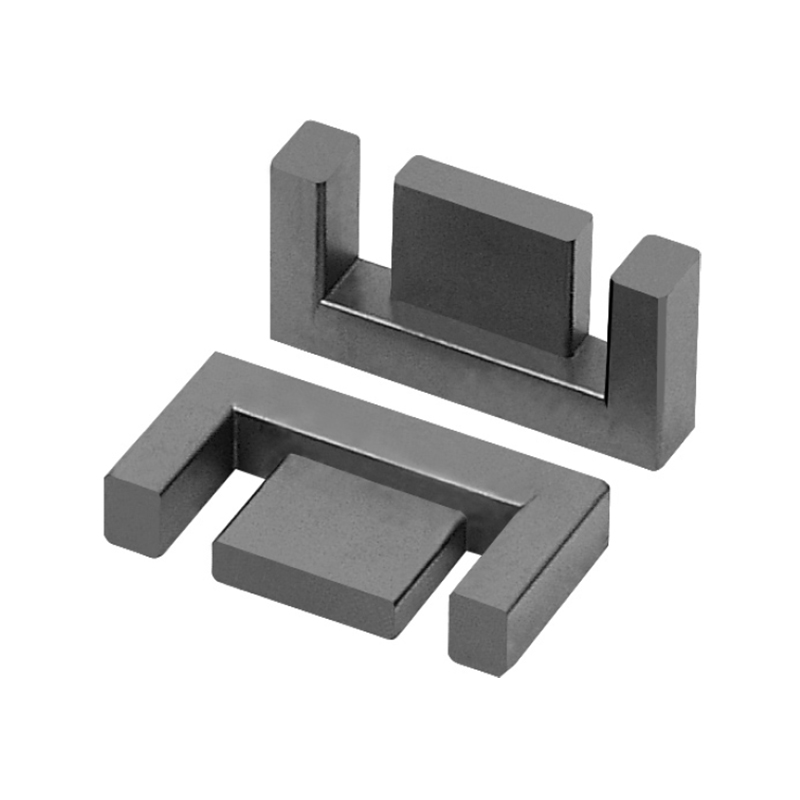
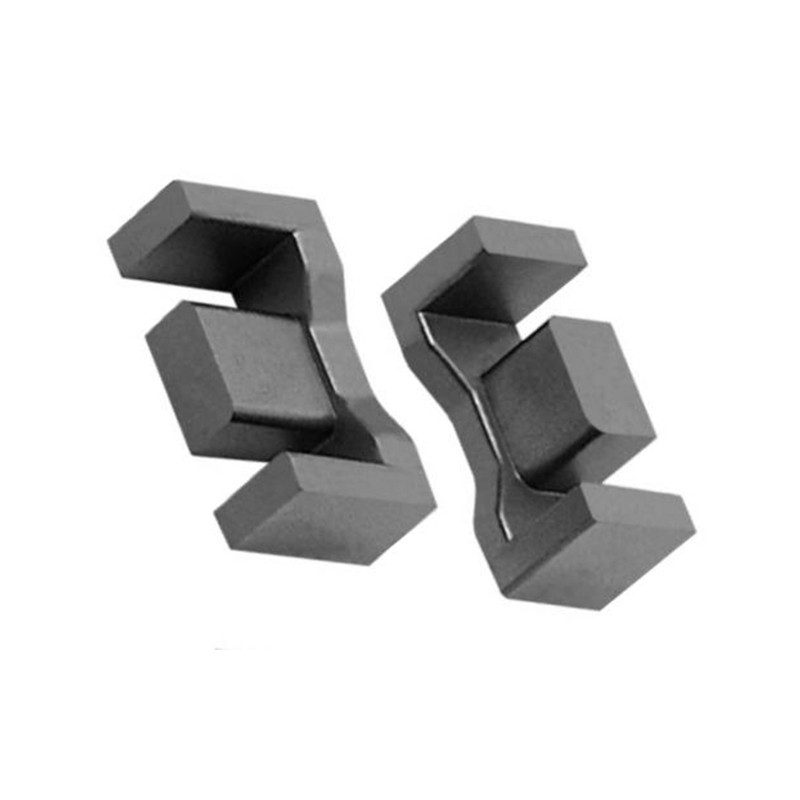
EF20 belongs to the two-piece 20 mm core family. An E-shaped half with a round center post mates with its counterpart around a two-piece bobbin, and the assembly is clamped or bonded through mounting features that have stayed essentially unchanged for decades. Outline dimensions have drifted slightly between manufacturers over the years, so treat catalog data as a family of similar parts rather than one fixed standard — and always design from the specific datasheet in hand.
| Parameter | Typical range for EF20 | What it drives in your design |
|---|---|---|
| Core pair outline | ≈20 × 18–19 mm, 5.5–7.5 mm stack | Footprint and enclosure clearance |
| Effective cross-section (Ae) | ≈30–40 mm² | Turns needed for a given flux swing |
| Effective path length (le) | ≈42–47 mm | Magnetizing current and H-field |
| Effective volume (Ve) | ≈1400–1800 mm³ | Scaling of total core loss |
| Winding window | ≈35–50 mm² | Turns, wire gauge, isolation margins |
| Ungapped AL (MnZn power grade) | ≈1800–2600 nH/N² | Baseline transformer inductance |
Why the Round Center Leg Earns Its Place
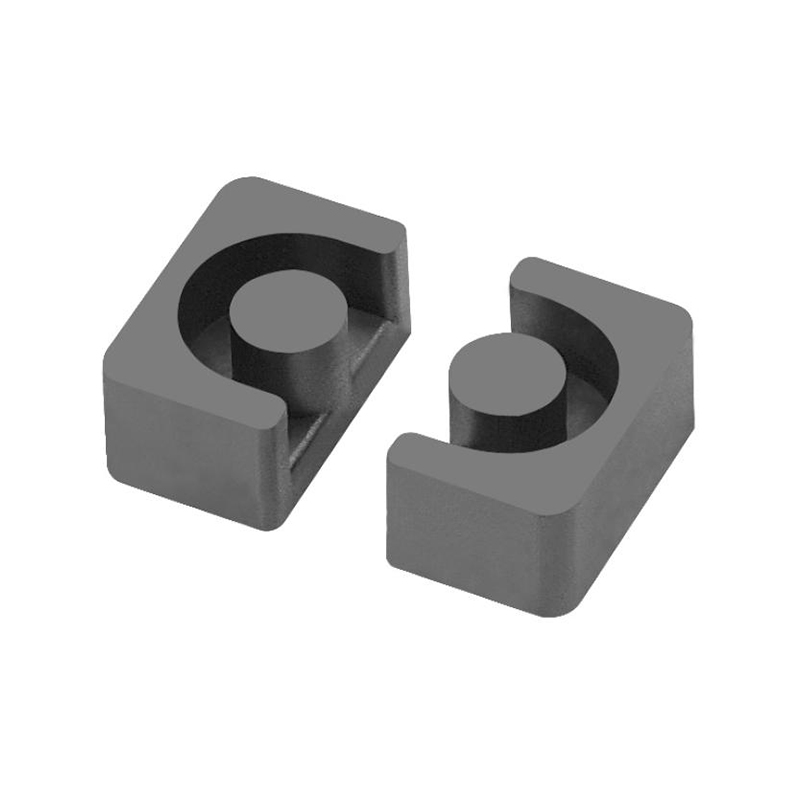
Round wire wrapping a round post sits at the same radius on every turn, so layer build stays even and mean length per turn (MLT) is predictable across the whole winding. That avoids the bunching you get at the corners of a square post, keeps DC-resistance estimates trustworthy before the first sample is wound, and lets simple two-piece bobbins use the window efficiently. At this power level, where round magnet wire is the norm, those small advantages compound into a cooler, quieter transformer.
EF20 Next to EE20 and EFD20
Within the same footprint class, the choice is mostly about profile height and winding style:
| Attribute | EF20 | EE20 | EFD20 |
|---|---|---|---|
| Center leg shape | Round | Square | Flat and wide |
| Profile | Moderate | Moderate | Low |
| Winding style | Even layers on round wire, predictable MLT | More corner bunching on square post | Suits copper sheet and flat wire |
| Comfort zone | 15–50 W at 65–132 kHz | Same class with legacy tooling | Height-critical adapters and LED drivers |
Choosing the MnZn Grade Behind the Core
Core shape sets the geometry; the material inside it sets the losses. For transformer and power-inductor duty, MnZn power ferrite is the default pairing. Read the loss-density curve at your switching frequency and flux swing, and read it at operating temperature: well-developed power grades put their loss minimum near 80–100 °C, which is exactly where a sealed adapter or driver runs. Saturation moves with heat too — expect roughly 390–410 mT at 25 °C on a strong power grade, falling toward 300–330 mT at 100 °C — so size your flux swing from hot data rather than room-temperature numbers.
 MnZn Power Ferrite Cores for Transformers and Power InductorsMnZn power ferrite offers high saturation induction with low hysteresis and iron loss, suited to transformers and inductors. Its loss minimum near 80–100°C matches sealed adapter and driver operating temperatures discussed here.View Product →
Filter chokes and common-mode positions shift the requirement. There you want stable impedance across the noise band, which favors MnZn high-conductivity grades engineered for high-frequency loss control. These grades keep eddy-current losses in check as frequency climbs, which is why they appear in EMI suppression and signal-line filtering rather than in the main power path.
Mn-Zn High Conductivity Ferrite for EMI Suppression and FilteringHigh-conductivity MnZn ferrite keeps eddy-current losses in check at high frequency, providing stable impedance for filter chokes and common-mode positions where EMI suppression and signal-line filtering demand loss control.View Product →
One more lever sits upstream of the core itself. Because our YR material grades are formulated and milled from powder in-house, loss behavior and AL distribution can be tuned batch by batch against a customer's operating point — worth raising with a supplier when a standard catalog grade leaves margin on the table.
Ungapped or Gapped: Setting AL for the Job
Flyback and forward transformers want every microhenry, so they run ungapped and inherit the material's natural AL — around 2000 nH/N² in this size class. Energy-storage inductors behave differently: a ground center leg stabilizes inductance against DC bias and turns AL into a controlled, specifiable number instead of a property you inherit. The trade-off is fringe-field loss around the gap, which grows with gap length and is managed by distributing the gap or selecting a grade with good behavior under bias. The practical differences between gapped and ungapped MnZn ferrite cores deserve a full read before you fix the gap dimension on your drawing.
Whatever you choose, specify AL with a tolerance — ±10% is typical on ground legs — and agree the lapping finish in writing, because surface roughness behaves like an invisible extra gap that drags effective AL down. A supplier who grinds and measures in-house delivers tighter AL histograms, and your unit-to-unit spread in magnetizing current follows that distribution directly.
Design and Procurement Checks Before Tooling
Six checks catch most EF20 problems while they are still cheap to fix:
- Confirm Ae, le, and Ve from the supplier's own datasheet rather than a generic drawing — a 10% difference in Ae changes your turns count directly.
- Read core loss density at your frequency, flux swing, and expected hot-spot temperature; extrapolating from 25 °C curves is the most common source of thermal surprises.
- Lay out the winding on a real bobbin, with margin tape for reinforced isolation and creepage distances that survive production, not just the lab bench.
- Check saturation margin at maximum temperature and worst-case transient, including start-up and short-circuit events.
- Fix AL tolerance, gap specification, and test method in writing before volume release.
- Sample the core on your own winding line — MLT and thermal behavior inside your enclosure say more than any published curve.
Sourcing questions matter as much as design questions. Ask prospective suppliers for batch-level loss curves and AL histograms rather than a single typical page. As a manufacturer running the full chain from ferrite powder through pressing and sintering to finished cores — with ISO 9001 and automotive-grade quality systems behind it — we treat those distributions as part of the product. Teams that prefer finished parts over bare cores can also source complete transformer builds; our EE and PQ series carry CQC and UL certification, and the same winding discipline carries over to custom EF-based designs.
Custom Transformer Manufacturer with Certified EE and PQ SeriesThe manufacturer supplies complete transformer builds alongside cores, with EE and PQ series carrying CQC and UL certification. Teams sourcing finished transformer parts rather than bare cores can extend the same discipline to custom EF-based designs.View Product →
To request EF20 samples, complete datasheets, or a gapped-core quote matched to your switching frequency, contact our engineering team and share your operating point.
The EF20 has outlived several generations of switching topologies because the geometry still fits the power levels where most converters actually live. Pair it with a loss-optimized MnZn power grade, respect the hot-temperature numbers, and lock AL specifications with a supplier who measures them — and the core will quietly do the rest of its job.
Previous Post
No previous article
Next Post
PFC Boost Converter Design: Ferrite Core Selection and Practical Guide