
 English
 한국어
 中文简体
Home / News / Industry News / Ferrite Rod Guide: Material Choice, Rod Geometry and Effective Permeability
Ferrite Rod Guide: Material Choice, Rod Geometry and Effective Permeability
Content
- 1 What a ferrite rod does that a plain coil cannot
- 2 MnZn or NiZn: the frequency decides before the data sheet does
- 3 Length-to-diameter ratio, not diameter, drives effective permeability
- 4 Winding, tuning and Q: where rod designs are usually lost
- 5 What to put on the purchase order for ferrite rods
- 6 Frequently asked questions about ferrite rods
A ferrite rod does two jobs at once: it gathers magnetic flux from a field far wider than its own cross-section, and it lifts the inductance of the coil wound on it by an order of magnitude. A 50 mm manganese-zinc rod carrying 150 turns of 0.2 mm copper will read several hundred microhenries on an LCR meter, where the same coil in air reads only a few.
Design reviews on rod antennas tend to fail in one of two places. Either the grade is picked for permeability alone and the operating frequency is checked later, or the rod is drawn to fit a housing without anyone asking what length-to-diameter ratio that housing allows. Both mistakes cost far more than the part, because a rod that is 40 percent short on effective permeability cannot be rescued by tuning.
150 to 400 microhenries Untuned inductance of a typical 50 mm MnZn rod wound with 100 to 200 turns; most of that tolerance band comes from the core, not the winding
What a ferrite rod does that a plain coil cannot
A ferrite rod concentrates magnetic flux along its axis, so a coil wound on it links more flux per turn than the same coil in free space. In a receiving antenna the rod collects field energy; in a transmitting coil or a filter inductor it multiplies the flux produced per ampere.
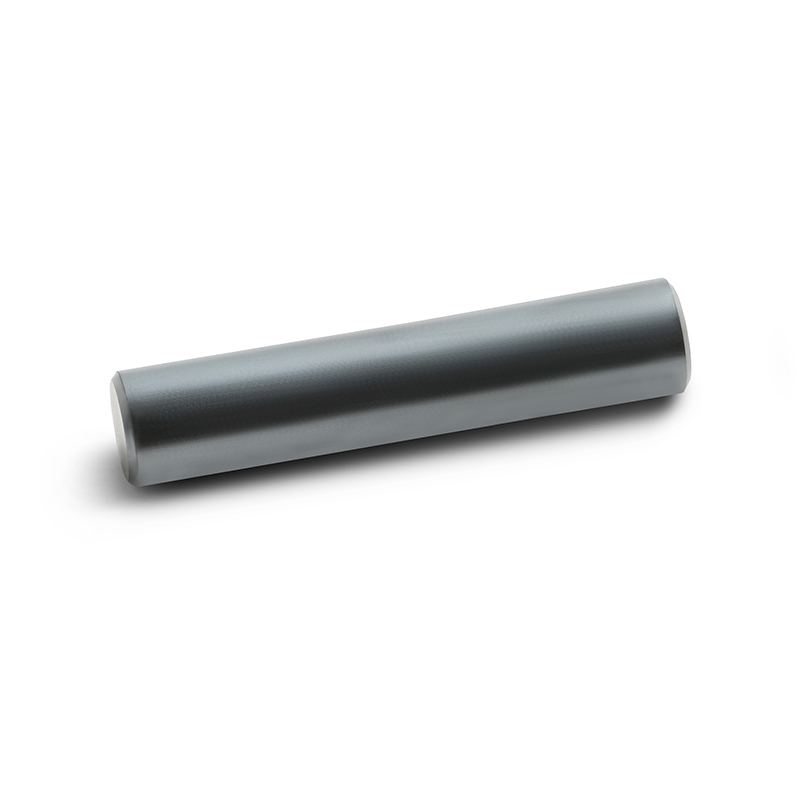
Ferrite rod
A solid, elongated core of sintered soft ferrite, usually manganese-zinc or nickel-zinc, with a length several times its diameter, used to raise the inductance of an axial winding, capture low-frequency magnetic fields, or shape flux in sensors and wireless power coils.
The point that decides most designs is that a rod is an open magnetic circuit. There is no return path through the material, so flux leaves at one end and re-enters at the other through air. That geometry caps how much of the material's permeability you can actually use, which is why rod data sheets must quote dimensions and initial permeability together.
2000-3000 Initial permeability of high-permeability MnZn rod grades
10:1 to 20:1 Length-to-diameter range used by most antenna rods
1 MHz Practical ceiling for MnZn rods before loss dominates
120 C Curie point of a typical high-permeability MnZn grade
MnZn or NiZn: the frequency decides before the data sheet does
Below about 3 MHz, MnZn ferrite is the right material for a ferrite rod; above it, NiZn grades take over even though their permeability is far lower.
The reason is resistivity. MnZn ferrite conducts weakly, in the range of a few ohm-metres, so eddy currents circulate inside the rod as frequency climbs and turn signal into heat. NiZn is several orders of magnitude more resistive, which is why it holds its Q into the tens of megahertz. A 125 kHz reader or an AM broadcast antenna never notices the difference; a 13.56 MHz reader notices immediately.
MnZn rod
- Initial permeability 1000 to 5000
- Working band from 10 kHz to about 1 MHz
- Highest flux capture per millimetre of length
- Permeability drifts noticeably with temperature
- Lowest cost per part in volume
NiZn rod
- Initial permeability 20 to 800
- Working band from 1 MHz to beyond 50 MHz
- Lower flux capture, far lower eddy-current loss
- Flatter Q across the high-frequency band
- Preferred for HF readers and EMI work
| Grade family | Initial permeability | Resistivity | Usable band | Typical rod use |
| MnZn high permeability | 1500-5000 | Low | 10 kHz-1 MHz | AM and LW antennas, 125 kHz RFID, wake-up coils |
| MnZn power | 1000-3000 | Low | 20 kHz-1 MHz | Wireless charging concentrators, filter inductors |
| NiZn medium permeability | 100-800 | High | 1-30 MHz | HF antennas, suppression rods, sensor cores |
| NiZn low permeability | 20-100 | Very high | 30-300 MHz | VHF rods, wideband transformers |
 Soft Ferrite Materials, MnZn Grades, and TransformersReview soft ferrite powder, MnZn power and high-permeability grades, and transformer options for applications where permeability spread and frequency-dependent losses matter.View Product →
For a rod that will be tuned by a capacitor and used as a receiver, the practical question is not which family is better but which grade inside the family has a permeability spread your tuner can absorb. A grade quoted at 2000 with a plus or minus 25 percent window forces a wide tuning range, and the wider the range, the lower the Q at the band edges. The site's comparison of MnZn versus NiZn core selection walks through the same trade-off from the core side.
Length-to-diameter ratio, not diameter, drives effective permeability
For a rod of a given grade, effective permeability rises steeply with length-to-diameter ratio and flattens after roughly 20:1, so extra length buys far more than extra diameter.
The demagnetizing field at the rod ends is the reason. Flux lines leave the material and return through air, and a short, fat rod loses a larger share of its flux that way. Treating the rod as a prolate spheroid is close enough for design work, and it explains why a 10:1 rod realises only a small fraction of the permeability printed on the grade certificate.
10:1
47
20:1
129
30:1
225
50:1
410
100:1
700
Effective permeability of a cylindrical rod with initial permeability 1000, plotted against length-to-diameter ratio
Design shortcut
If a 10:1 rod made from a 1000-permeability grade lands near 47 in effective permeability, going to 20:1 reaches roughly 129 without changing the material. Every further doubling of length returns less than the one before, so the cheapest gain is almost always in that first step.
Winding position matters as much as rod length. A coil centred on the rod sees the highest effective permeability, while a coil pushed to one end sees noticeably less. If the mechanical drawing moves the winding to the end of the rod to reach a connector, expect to add turns or accept a lower inductance.
Winding, tuning and Q: where rod designs are usually lost
The rod sets the flux, but the winding and the tuning capacitor set the electrical result, so both must be specified at the operating frequency rather than at 1 kHz.
Fix the length from the band
A 50 to 60 mm rod is enough for a 125 kHz read head, while AM broadcast rods run 100 to 200 mm because the signal is weaker and the wavelength longer.
Set turns for the inductance target
Inductance rises with the square of turns and with the rod's effective permeability. Start from a measured sample rather than a calculation; a single-layer winding of 100 turns on an 8 by 50 mm rod usually lands in the low hundreds of microhenries.
Wind for Q, not just inductance
Evenly spaced single-layer turns of litz or stranded wire keep AC resistance down. Crowded windings raise self-capacitance and pull self-resonance toward the working frequency.
Tune and verify at frequency
Measure inductance and Q at the real operating frequency, then check the tuning range against the permeability window of the grade you bought.
A rod that measures 300 microhenries at 1 kHz will read lower at 125 kHz once winding capacitance and core loss are included. Tune with the coil on the rod, inside the housing, at the temperature the product actually runs at.
What to put on the purchase order for ferrite rods
A rod purchase order should pin down five things: material grade and permeability tolerance, dimensions and straightness, Curie temperature, surface condition, and the method the supplier uses to prove them.
Rods are normally diamond-ground to length from pressed and sintered blanks, so achievable tolerances are tighter than for pressed shapes but not free. Grinding also leaves micro-cracks at the cut face, which is why a supplier who measures inductance on a wound sample tells you more than one who only checks a drawing.
| Parameter | Typical requirement | Why it matters |
| Initial permeability | Grade value, plus or minus 20 percent at 25 C, measured at 10 kHz | Sets inductance and the tuning range |
| Diameter and length | Plus or minus 0.2 mm on diameter, plus or minus 0.5 mm on length | Coil fit and repeatable inductance |
| Straightness | 0.1 mm maximum bow over 50 mm | Clearance in automated winding |
| Curie temperature | 120 C minimum for high-permeability MnZn, 200 C for power grades | Thermal margin in the application |
| Surface condition | No chips above 0.5 mm, no through cracks | Mechanical strength and insulation |
Permeability begins in the powder blend, so the supplier's control over calcination and sintering shows up later as lot-to-lot spread in your tuning range. A vertically integrated producer that controls soft magnetic ferrite powder and the sintering profile can hold that spread tighter than a trader buying finished rods on the open market.
Integrated Soft Ferrite Powder and Sintering ControlIntegrated soft ferrite powder development and sintering control help limit lot-to-lot permeability spread; grade data and wound samples are available through contact.View Product →
Before releasing a rod drawing, ask for ten wound samples from a single lot and measure inductance at the operating frequency. The spread across those ten parts is the tolerance your tuner really has to cover, and it is almost always wider than the grade table suggests. Sample requests and grade data go through the contact page.
Frequently asked questions about ferrite rods
Can a ferrite rod work at 13.56 MHz?
Only with NiZn material. MnZn rods turn lossy above roughly 3 MHz because eddy currents circulate in the low-resistivity core, and antenna Q collapses before reading distance improves.
Does a longer rod always give more inductance?
Yes, but with diminishing returns. The first doubling of length typically returns more than a factor of two in effective permeability, while later doublings return less; past about 20:1 the gain per added millimetre rarely justifies the space.
Why does the inductance of my rod antenna drift?
Permeability of high-permeability MnZn grades changes with temperature, typically by a few percent over a minus 20 to 60 C span, and mechanical clamping adds stress that shifts it further. Tune at the temperature the product really runs at, or specify a grade with a flatter curve.
Can ferrite rods be cut to length in-house?
They can be diamond-cut, but abrasive sawing leaves micro-cracks that weaken the part and can change inductance at the cut face. Buying rods ground to length is more predictable unless you have a wet saw and a way to inspect the cut.
Most rod problems are geometry problems wearing a materials costume. Fix the frequency band, then the length-to-diameter ratio, and only then argue about grade numbers.
Previous Post
No previous article
Next Post
Custom Magnetics Design: Practical Engineering, Thermal, and Sourcing Guide