
 English
 한국어
한국어 中文简体
中文简体Home / News / Industry News / What Is Manganese-Zinc Ferrite? Properties, Applications, and Selection Guide
What Is Manganese-Zinc Ferrite? Properties, Applications, and Selection Guide
Content
Many engineers start a switch-mode power supply design with the same question: which magnetic material should carry the transformer and inductor cores? For a 150 kHz LLC converter, a 60 W flyback, and even a 3 kW on-board charger, the answer is usually the same: manganese-zinc ferrite. MnZn ferrite combines high initial permeability, high saturation flux density, and low core loss in the 10 kHz to 2 MHz band, which covers most power-conversion circuits built today. The real decision is therefore rarely whether to use MnZn ferrite, but which grade to use and how to source it reliably.
What Manganese-Zinc Ferrite Is
Manganese-zinc ferrite is a soft magnetic ceramic formed by sintering iron oxide (Fe2O3), manganese oxide (MnO), and zinc oxide (ZnO). The resulting spinel crystal structure gives the material its magnetic character, and small changes in the oxide ratio and sintering profile produce very different grades. The same basic recipe, fired differently, can yield a 2,300-permeability power core or a 10,000-permeability signal core.
| Property | Typical MnZn range |
|---|---|
| Initial permeability | 700 – 15,000 |
| Saturation flux density at 25°C | 350 – 530 mT |
| Coercivity | 5 – 25 A/m |
| Resistivity | 0.1 – 10 Ω·m |
| Curie temperature | 100 – 250°C |
| Practical frequency ceiling | Up to 2 MHz for power grades |
Two values in the table deserve extra attention. Saturation flux density determines the minimum core cross-section for a given power level, and Curie temperature defines the absolute thermal limit. If the core approaches the Curie point, permeability collapses and the component stops acting as an inductor. Power grades therefore use a Curie temperature well above 200°C so the usable range stays far from the danger zone.
Why MnZn Ferrite Is the Default for Power Conversion
MnZn ferrite is the default for power conversion because no other mass-produced material matches its combination of high flux capacity, low loss, and economical processing. Metal-alloy cores saturate at higher flux density but suffer large eddy-current losses above a few kilohertz. NiZn ferrite behaves well at high frequency but offers lower saturation, which means larger cores at power frequencies. MnZn sits between them: saturation flux density around 400-500 mT, core loss low enough for practical transformer design below 2 MHz, and processing cost low enough for mass production.
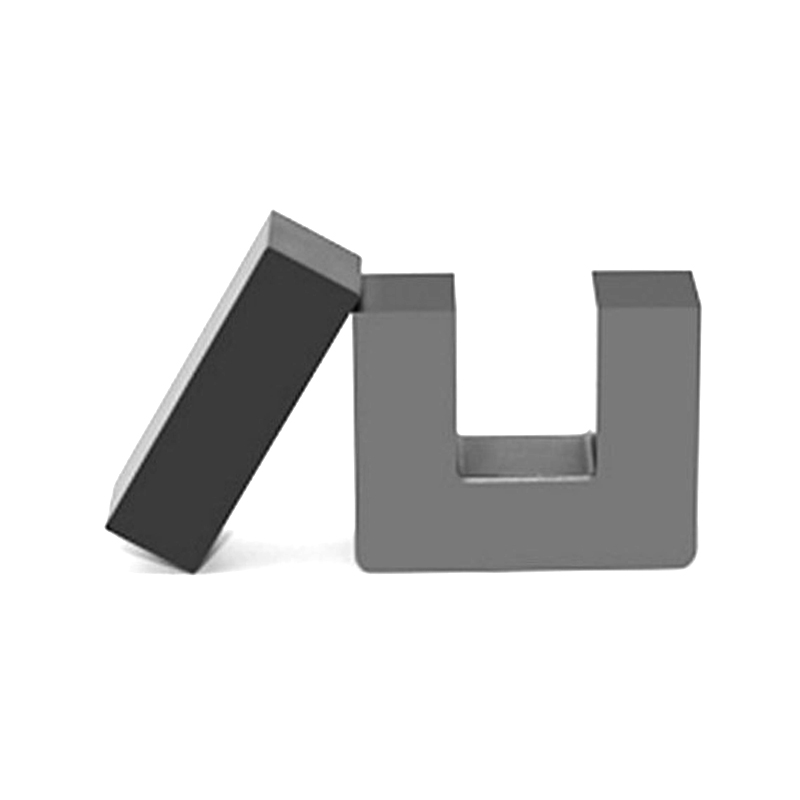
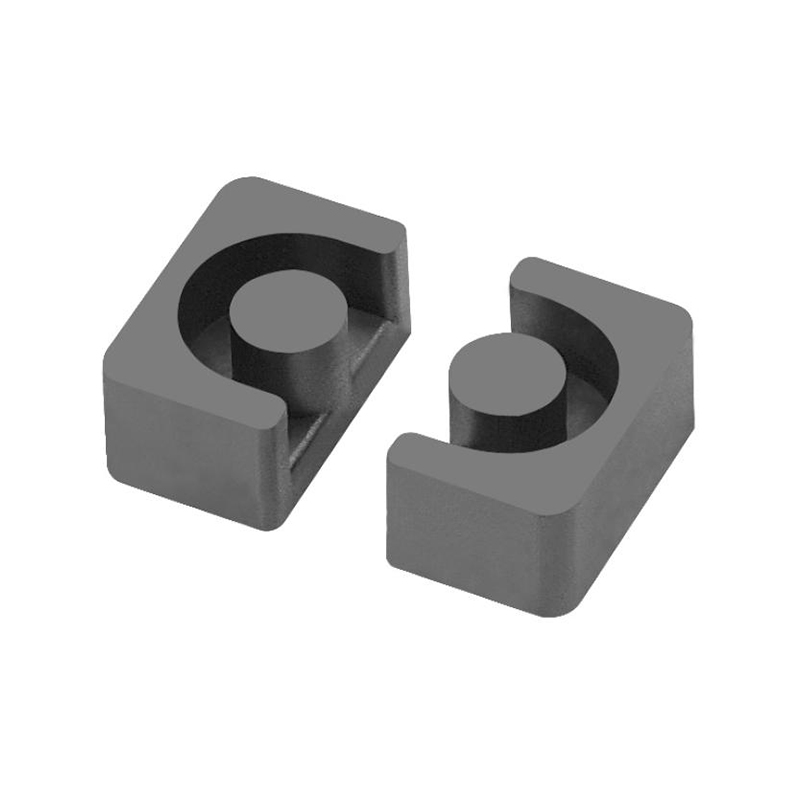
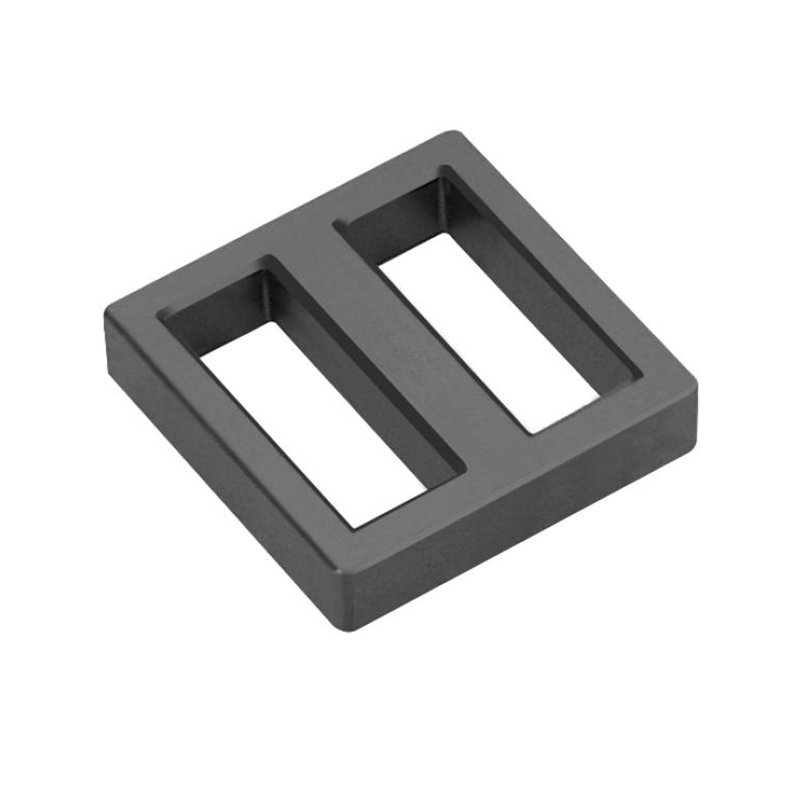
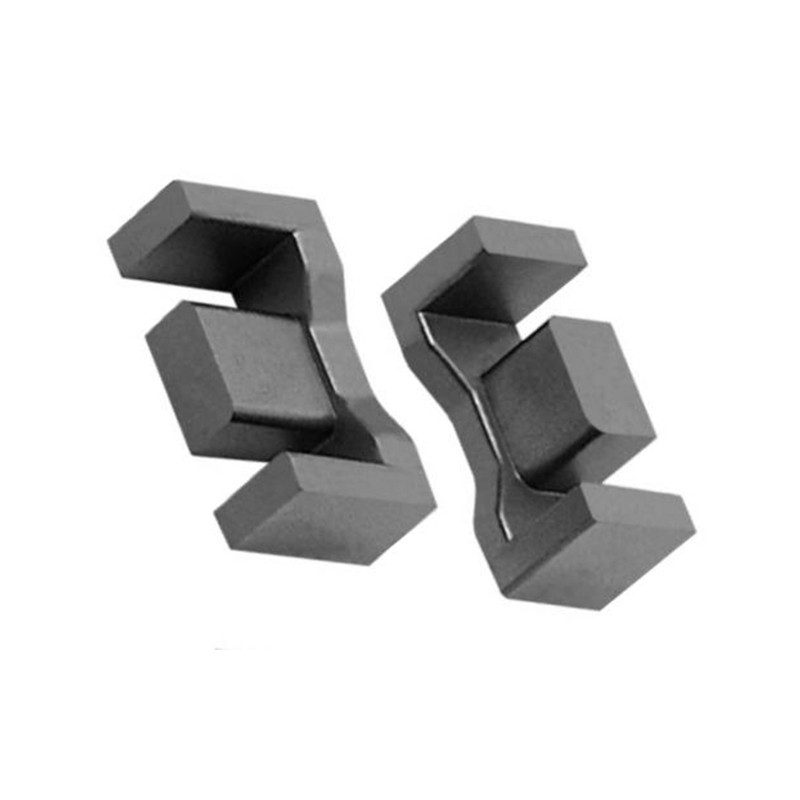
At 100 kHz and 200 mT, a good MnZn power grade loses roughly 300-450 mW/cm³ at 100°C, a level that allows compact transformer designs with modest cooling. At 500 kHz the same grade loses several times more, which is why designers moving to higher frequencies choose low-loss grades formulated for that window. The loss is made of three parts: hysteresis loss, eddy-current loss, and residual loss. Hysteresis loss dominates at lower frequency and higher flux density; eddy-current loss grows with the square of frequency; residual loss becomes visible only near the material's frequency limit. Because eddy-current loss also depends on resistivity, high-frequency MnZn grades are engineered with modified composition to raise resistivity without giving up saturation. For converters pushing toward 1 MHz and beyond, specialized materials such as the Mn-Zn high conductivity ferrite extend the family's useful range before a switch to NiZn becomes necessary. For ordinary power designs, the dedicated MnZn power ferrite product family covers the range from small flyback cores to large LLC transformer cores.
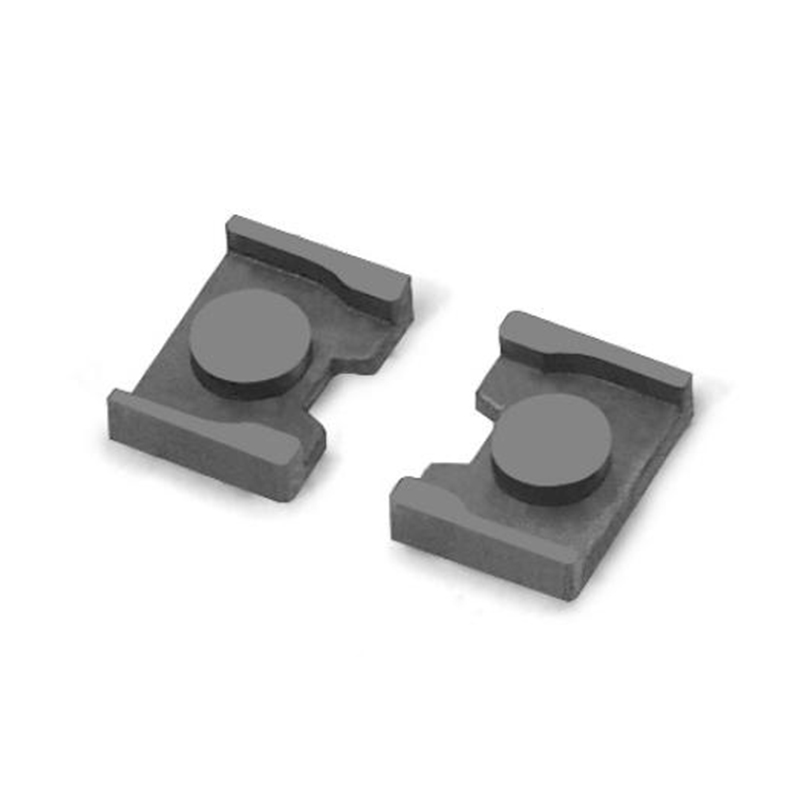
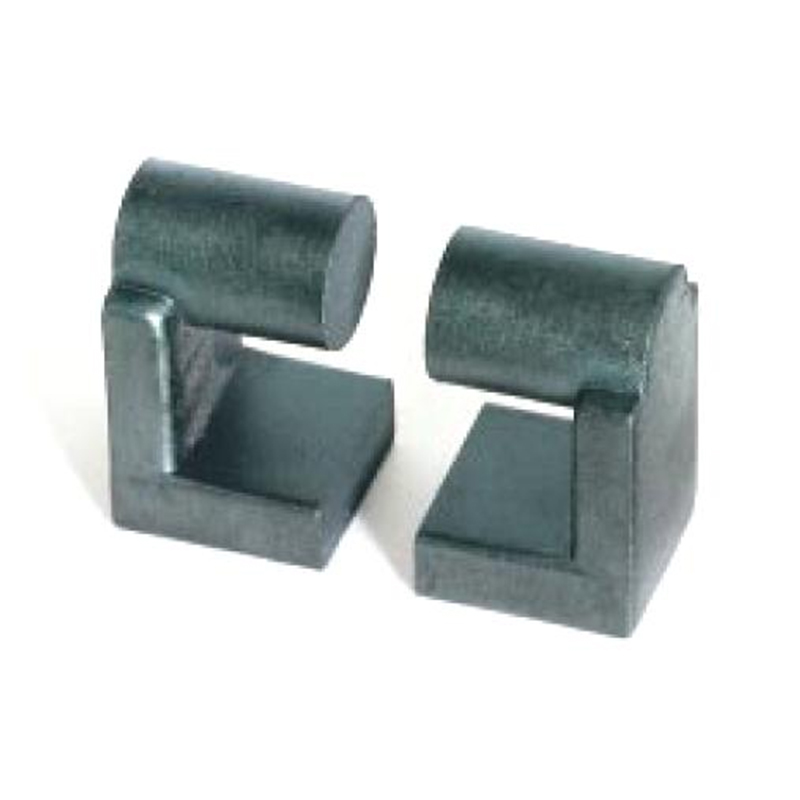
 MnZn Ferrite Core Manufacturers, Mn-Zn Ferrite SuppliersTongxiang Yaorun Electronics Co., Ltd. is China Mn-Zn ferrite suppliers and OEM/ODM MnZn ferrite core manufacturers, our factory offer wh...View Product →Mn-Zn High Conductivity Ferrite Manufacturers, SuppliersAs China OEM/ODM Mn-Zn high conductivity ferrite manufacturers and suppliers, Tongxiang Yaorun Electronics Co., Ltd. manufacturing of who...View Product →
How MnZn Compares with NiZn Ferrite
Designers sometimes assume higher permeability is always better. It is not. MnZn ferrite offers permeability an order of magnitude above NiZn, but its lower resistivity pulls the practical ceiling down to a few megahertz. NiZn cores, with resistivity up to a million times higher in some grades, remain nearly lossless at radio frequencies; their saturation flux density is lower, however, and permeability rarely exceeds 2,000. The engineering rule: below about 2 MHz for power circuits, use MnZn; above that, move to NiZn or a specialized high-frequency ferrite.
| Parameter | MnZn ferrite | NiZn ferrite |
|---|---|---|
| Initial permeability | 700 – 15,000 | 15 – 2,000 |
| Resistivity | 0.1 – 10 Ω·m | 1,000 – 1,000,000 Ω·m |
| Saturation flux density | 350 – 530 mT | 250 – 400 mT |
| Practical frequency range | Up to 2 MHz | 1 MHz to hundreds of MHz |
| Typical applications | Power transformers, inductors, EMI chokes | HF inductors, antennas, RF chokes |
A quick visual check helps in the lab: MnZn cores are dark gray to black, while NiZn cores are lighter and often reddish or tan.
How to Select the Right MnZn Ferrite Grade
Selecting an MnZn ferrite grade comes down to five checks: operating frequency, loss budget, DC bias, operating temperature, and permeability. Frequency comes first because it defines the dominant loss mechanism; the designer then compares core-loss curves at the expected flux density and picks the smallest core cross-section that meets the temperature-rise limit.
- Operating frequency: below 100 kHz, standard power grades work well; from 100 kHz to 500 kHz, choose low-loss power grades; above 500 kHz, use high-frequency MnZn materials.
- Loss budget: compare core-loss curves in mW/cm³ at the actual flux density, frequency, and temperature, not just the grade name.
- DC bias: for inductor designs, verify how much initial permeability remains at the rated bias current; grades with higher saturation flux density hold inductance better.
- Temperature profile: MnZn power grades usually place the minimum loss between 70°C and 120°C, so pick a grade whose loss minimum matches the working temperature of the core.
- Permeability: higher is not automatically better; high-permeability cores saturate sooner and are harder to gap. Power designs typically start with 2,000-3,000 permeability grades.
Published grade tables make these checks practical. A typical MnZn power grade lists initial permeability 2,300 ±20%, saturation flux density 510 mT at 25°C and 390 mT at 100°C, Curie temperature above 215°C, and a core-loss curve whose minimum sits at 100°C. When comparing datasheets, always check the temperature at which the loss was measured; a grade that looks excellent at 25°C can be the wrong choice for an enclosed power supply that runs at 90°C. A practical checklist of the five specs engineers check first when selecting MnZn cores covers these decisions in greater detail.
Typical Applications of MnZn Ferrite
MnZn ferrite cores appear wherever electrical energy is converted, filtered, or coupled. The main application groups are:
- Switch-mode power supplies: LLC and flyback transformers, output inductors, PFC chokes in the 10 kHz to 2 MHz band.
- EMI suppression: high-permeability MnZn rings in common-mode chokes and noise filters.
- Automotive electronics: DC-DC converters, on-board chargers, and battery-management isolation components.
- Renewable energy: transformers and inductors in photovoltaic inverters and battery storage.
- Wireless charging: high-frequency power transfer coils and magnetic shielding plates.
- Lighting drivers: small MnZn transformers and power-factor-correction inductors in LED drivers.
MnZn ferrite does not stop at the bare core. Because the material only becomes useful after it is wound, many buyers prefer finished components. A MnZn ferrite transformer that arrives wound, insulated, and safety-approved removes a large amount of variability from the supply chain; the magnetic, thermal, and certification work is already done.
Transformers Manufacturers, Wholesale transformers SuppliersAs China transformer manufacturers and OEM/DOM transformer suppliers, Tongxiang Yaorun Electronics Co., Ltd. focus on manufacturing of wh...View Product →Sourcing MnZn Ferrite: What to Verify
Batch consistency is the hidden risk in MnZn ferrite sourcing. Two production lots of the same nominal grade can differ in permeability by more than 20%, and core-loss values can shift by 20-30% when raw materials or sintering conditions drift. A line that starts with powder purchased from a broker has less control than one that synthesizes the powder itself. A manufacturer covering the whole chain, from powder to fired core to wound component, keeps these variables under one process owner.
Tongxiang Yaorun Electronics, for example, sinters soft ferrite powder in its own plant, produces MnZn power cores and MnZn high-conductivity cores, holds ISO/TS 16949 quality certification, and winds transformers on the same site. The practical benefit of this vertical integration is traceability. When an incoming lot shows a permeability deviation, the manufacturer can trace the cause to the powder batch, the sintering furnace, or the grinding step, rather than pointing to an external supplier. For the buyer, it also means the option to tighten a permeability band, request a custom grade, or discuss requirements directly with the manufacturer before ordering. That kind of direct technical exchange is often where the real time is saved.
The practical takeaway is simple. Manganese-zinc ferrite remains the material of choice for transformers and inductors in the power-conversion band up to about 2 MHz. Performance differences between grades are large enough to decide the thermal behavior of a final product, so grade selection should be based on loss curves at the working frequency and temperature, not on nominal permeability alone. And because batch consistency depends on process control, the right supplier controls the material from powder to finished core. Start with the grade, verify the curves, and choose a partner that understands the material as well as you understand your circuit.
Previous Post
Mn-Zn High Conductivity Ferrite: Properties, Applications and Selection Guide
Next Post
Manganese-Zinc Ferrite: Key Properties, Applications, and Selection Guide